
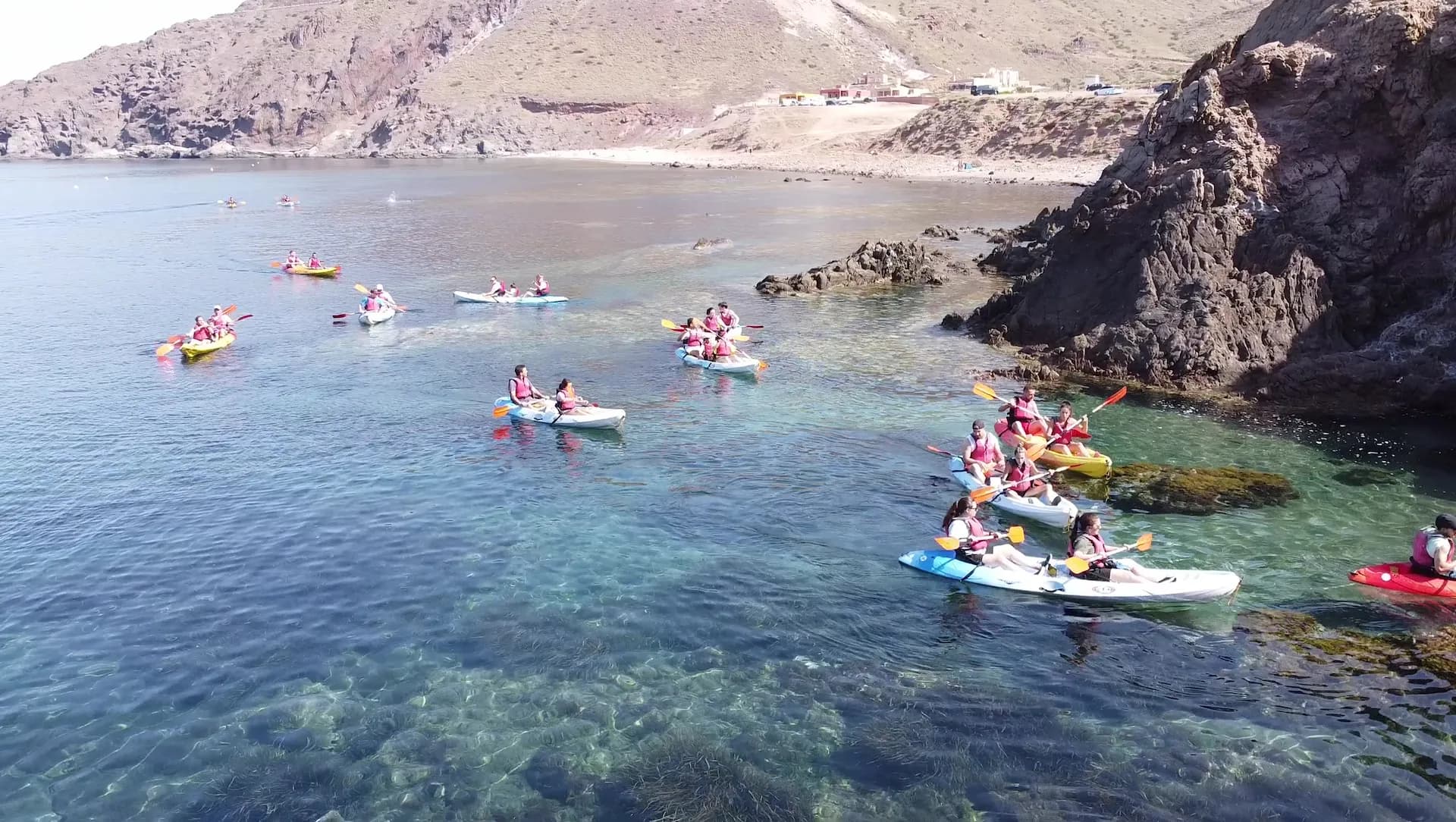
Kayak at Arrecife de las Sirenas – La Fabriquilla
The most spectacular volcanic reef in the Mediterranean
Tour information
- Duration: 3 hours
- Difficulty: All levels
- Price: Adults €35 · Children (4–10 years) €20
- Children: aged 4–10 do not paddle, they travel seated between the adults in the same kayak.
- Snorkel: Mask and snorkel tube included. Bringing your own is recommended for extra comfort.
- Schedule: Departures available at 9:30 and 16:30 (high season). Some days also available at 12:00. Check availability in the booking calendar.
- Departure point: La Fabriquilla or Las Negras depending on wind conditions. You will receive exact information by email the day before.
- What to bring: Swimwear, biodegradable sunscreen, water (minimum 1.5 litres), water shoes or flip-flops.
- Cancellation: Free cancellation up to 24 hours before. In the event of Poniente wind or adverse conditions, rescheduling at no cost.
Certified & authorised activity

Highlights
- Arrecife de las Sirenas: unique submarine volcanic formations found nowhere else in Europe
- Faro de Cabo de Gata: the oldest lighthouse on the Andalusian coast, seen from the sea
- Snorkelling at the reef with the best visibility in the Mediterranean
- 30-minute stop with privileged views of the Arrecife, a protected marine reserve
- Untouched volcanic coastline at the southernmost tip of the Natural Park, unreachable by land
What's included?
- High-stability sea kayak (single or double)
- Certified life jacket
- Paddle
- Snorkel included (mask and snorkel tube). We recommend bringing your own if you have one for extra comfort.
- Expert guide specialising in marine wildlife
- Activity insurance
- Hydration stop mid-route
- Experience photos
Experience it for yourself
Frequently Asked Questions
Is this a difficult route? Is there swell?
Can children participate?
Do I need to be able to swim?
Can I bring a camera?
Where is the departure point?
The ecosystem you will see
The Arrecife de las Sirenas route covers the southernmost and most marine-biodiversity-rich stretch of Cabo de Gata-Níjar Natural Park. Here the Marine Reserve, the Special Protection Area for Birds (SPA) and the famous salt flats converge, creating one of the most complete ecosystems on the European Mediterranean coast.
Volcanic geology
The Arrecife de las Sirenas is one of the most singular geological formations in the Mediterranean: the edge of a submarine volcanic crater that emerged from the sea millions of years ago. The ochre, reddish and black volcanic rocks result from hydromagmatic eruptions, where magma in contact with seawater generated explosions that fractured the rock into whimsical shapes. At low tide, formations emerge with silhouettes that, according to legend, gave rise to the name of the reef's "sirenas" (mermaids).
Marine fauna and birds
The reef waters are exceptionally clear and harbour large shoals of sea bream, European sea bass and white seabream. Marine Reserve protection has favoured the recovery of grouper and lobster. From the kayak it is possible to observe painted rays gliding over sandy beds. At Las Salinas, a short distance from the route, thousands of greater flamingos (Phoenicopterus roseus) feed in the shallows — one of Andalusia's most striking natural spectacles.
Posidonia oceanica
The extensive posidonia oceanica meadows surrounding the reef constitute one of the Mediterranean's most productive ecosystems. Considered a water quality bioindicator, posidonia only grows in clean, well-oxygenated seas. In Cabo de Gata these meadows reach exceptional densities — up to 700 bundles per m² — becoming the natural nursery for almost all commercial species in the western Mediterranean. Their presence guarantees the water transparency you will see throughout the route.
The route
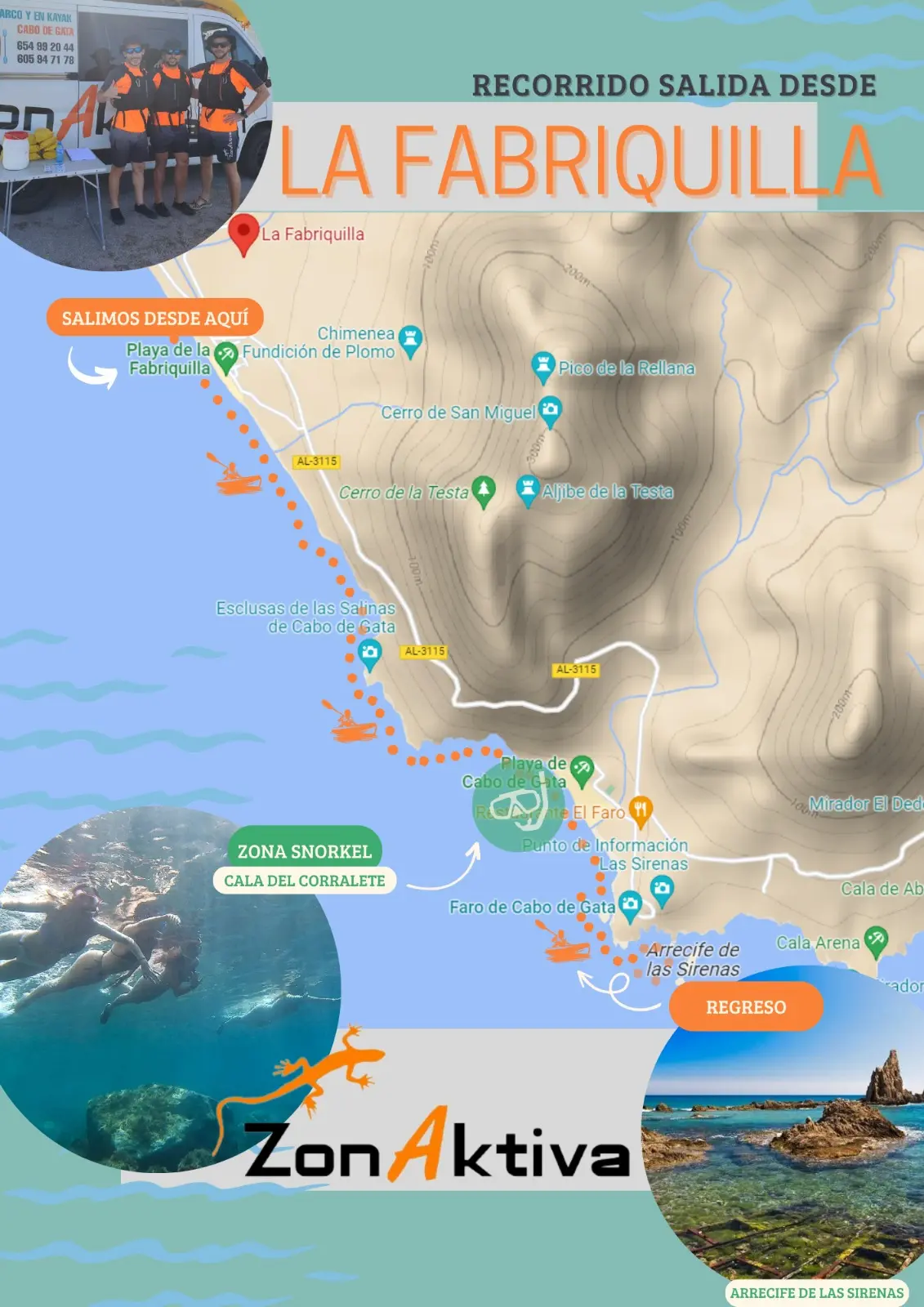
Route highlights
From La Fabriquilla to the Arrecife de las Sirenas, every point on this route is an unrepeatable experience along Cabo de Gata-Níjar Natural Park.
La Fabriquilla — Sheltered departure
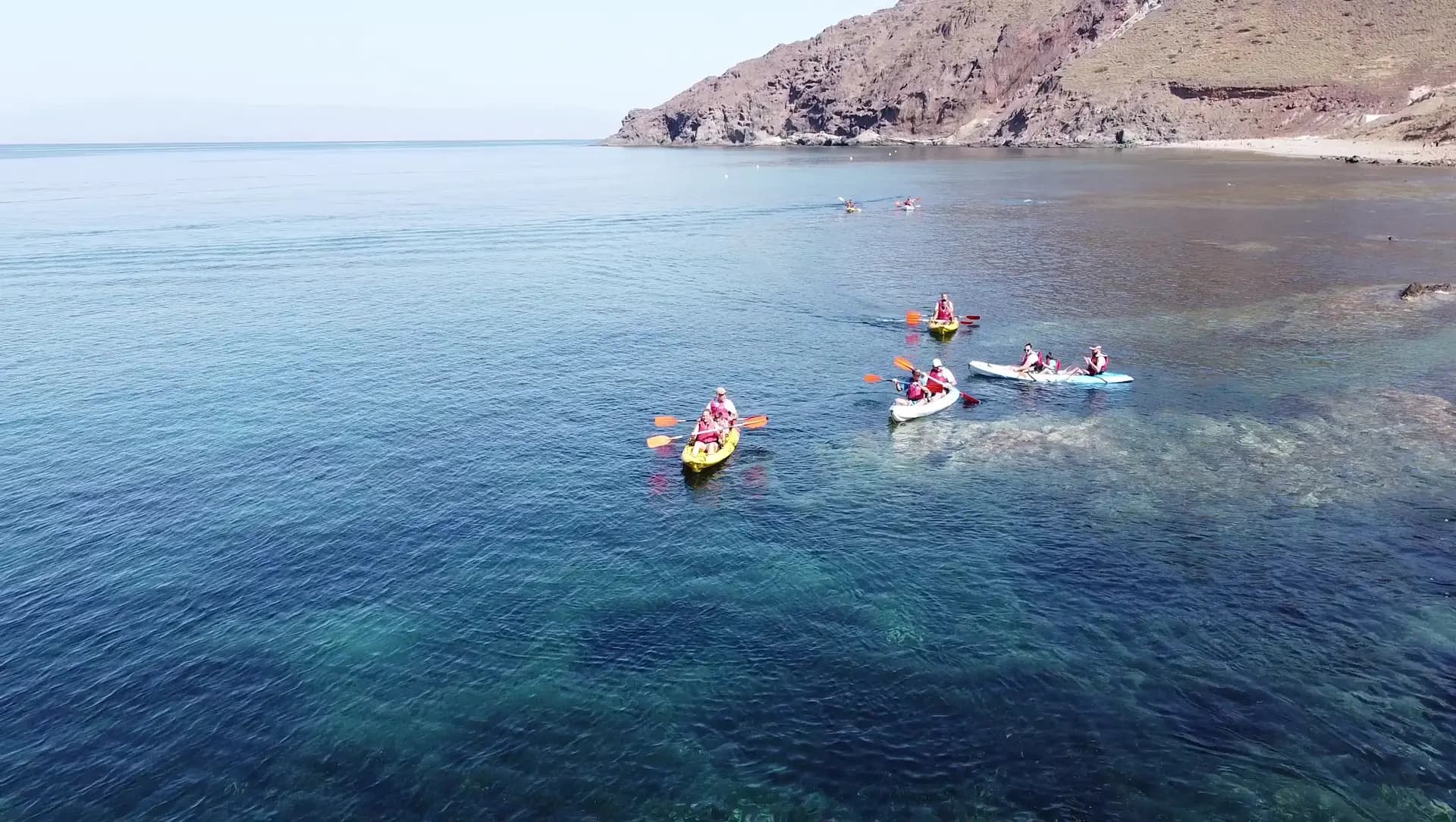
The route begins at La Fabriquilla cove, a natural bay sheltered from the Poniente wind where waters are usually calm even on breezy days. Its name comes from an old 19th-century fish cannery, of which traces remain on the shore. The entry into the water is easy and gradual, ideal for initial technical instruction. The volcanic formations of the reef are already visible from the shore, extending their platforms southward.
Volcanic coast — Crossing to the lighthouse
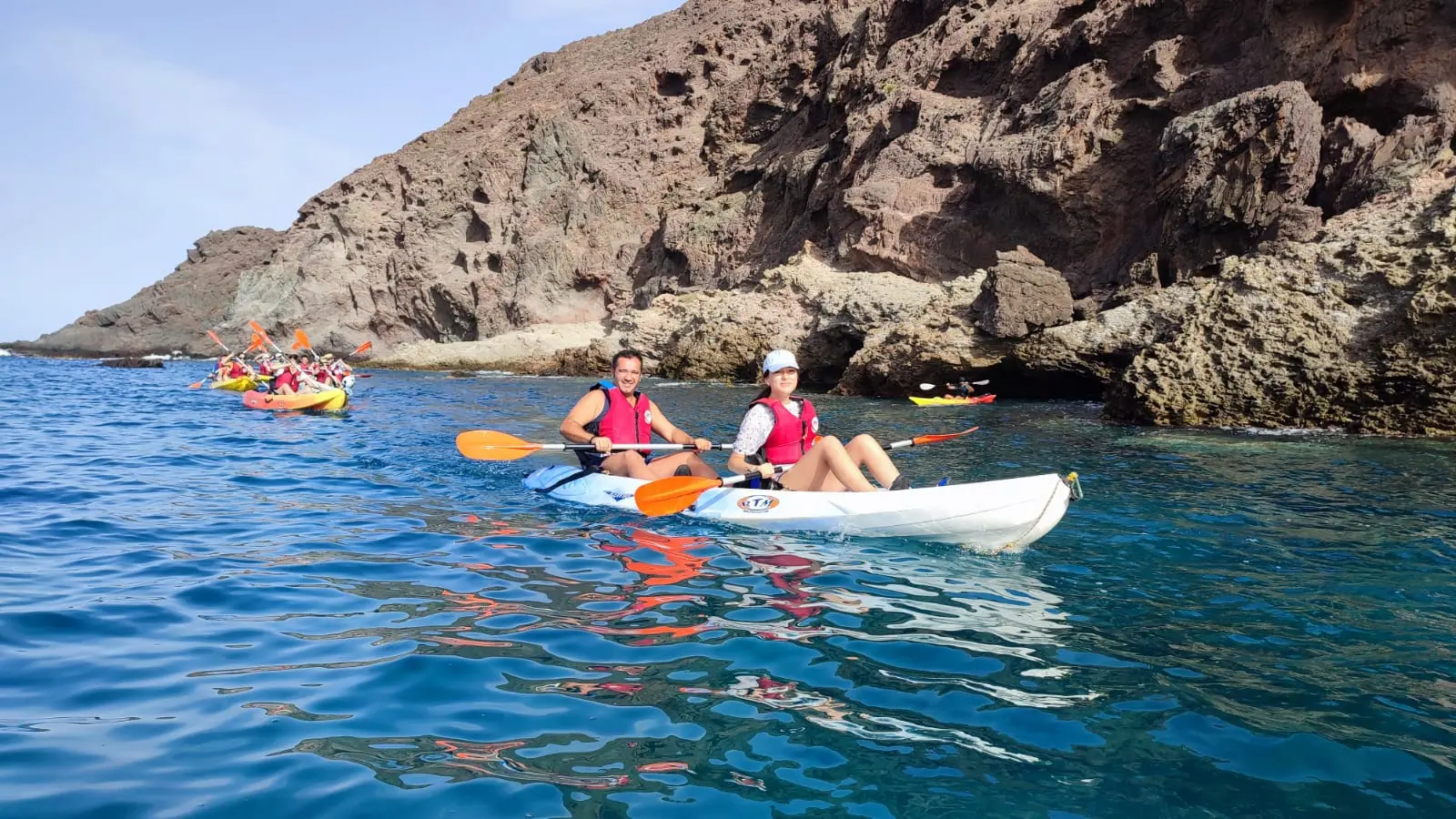
From La Fabriquilla we paddle south, skirting a coast of ochre, reddish and black volcanic cliffs, completely virgin and protected within Cabo de Gata-Níjar Natural Park. Water depth increases progressively and the bottom changes from sand to posidonia-carpeted volcanic rock, with visibility exceeding 20 metres on clear days. In the distance, the Cabo de Gata Lighthouse appears as our destination.
Cabo de Gata Lighthouse — The southern tip
The Cabo de Gata Lighthouse, built in 1863 on the southernmost volcanic promontory of the Natural Park, is the visual reference point of the entire excursion. Seeing it from the kayak, surrounded by the deep blue of the Mediterranean with no other motorised vessel in sight, is a visually intense experience difficult to describe. For centuries this lighthouse marked the navigation route of ships crossing the western Mediterranean between Europe and North Africa.
Arrecife de las Sirenas — The pinnacle moment
The highlight of the route is the Arrecife de las Sirenas itself, the most spectacular volcanic reef in the Spanish Mediterranean. The volcanic rock formations emerge from the water in overlapping platforms creating an underwater labyrinth of extraordinary beauty. Snorkelling here is unmatched: the combination of exceptional water clarity, posidonia oceanica meadows, rocky reefs and abundant marine life in the Reserve creates an experience that alone justifies the trip to Cabo de Gata.
History and curiosities of the area
The southern tip of Cabo de Gata has been a crossroads of civilisations for over 2,500 years. Phoenicians, Romans, Arabs and sailors from across Europe have left their mark on this coastline we now cross by kayak.
"Portus Magnus" — The Roman port
The Romans knew Cabo de Gata as "Promontorio Charidemi" and used it as a navigation landmark at the western Mediterranean's edge. Near La Fabriquilla stood a Roman-era fishing and salt port called "Portus Magnus," from which amphorae and archaeological remains have been recovered from the seabed. The salt from Las Salinas was one of the most valuable commodities in Roman trade in southern Hispania, used to produce garum, the famous fermented fish sauce exported throughout the Empire.
The lighthouse and the Sirenas legend
The Cabo de Gata Lighthouse was built in 1863 by engineer Jaime Font to guide ships through one of the Mediterranean's most dangerous stretches. The reef's name "de las Sirenas" (of the Mermaids) comes from the seafaring legend that described the volcanic formations as mythical creatures at low tide, whose unsettling silhouettes caused several shipwrecks before the lighthouse existed. The Spanish Navy records dozens of shipwrecks in these waters between the 16th and 19th centuries.
Las Salinas — 3,000 years of history
The Cabo de Gata salt flats are one of Andalusia's most important wetlands and have been in production since the Phoenician era, over 3,000 years ago. Their exploitation continued through the Roman, Arab and Christian periods, being a source of wealth for the region for centuries. Today, though salt production is minimal, the salt flats are a vital refuge for migratory birds: over 200 species have been recorded, including flamingos, godwits, sandpipers and various waders. From the kayak, on clear days, it is possible to make out the pink patches of flamingo colonies in the shallow waters of Cabo de Gata-Níjar Natural Park.
About the departure point
The day before your excursion we will contact you with the exact departure point. We depart from La Fabriquilla (Levante wind) or Las Negras (Poniente wind), depending on sea conditions that day.
Please don't worry. We will send you all the information about the departure point by email the day before your excursion.
Book your spot
Choose date and time — instant confirmation — free cancellation up to 24h before
Water temperature and conditions by season
Content pending completion
Spring
[Water temperature, typical wind, sea state...]
Summer
[Water temperature, typical wind, sea state...]
Autumn
[Water temperature, typical wind, sea state...]
Winter
[Water temperature, typical wind, sea state...]
What you will typically see on this route
Content pending completion
[Specific, frequent sightings: marine life, rock formations, notable moments particular to this route — to be filled in with the guides’ first-hand experience.]
Difficulty level compared to other routes
| Route | Difficulty |
|---|---|
| Kayak Arrecife de las Sirenas (this route) | All levels |
| Kayak at Las Negras | All levels |
| Kayak at Los Escullos | All levels |
| Kayak Agua Amarga | All levels |
| Kayak for Families with Kids | Beginner / family |
| Intermediate Routes (1 day) | Intermediate — prior experience required |
| Full Traverse (2–3 days) | Advanced — multi-day, good physical condition |
Tips from our guides
Content pending completion
[Personal recommendations from the guides: best time of day, what to bring, local tricks, an anecdote specific to this route...]
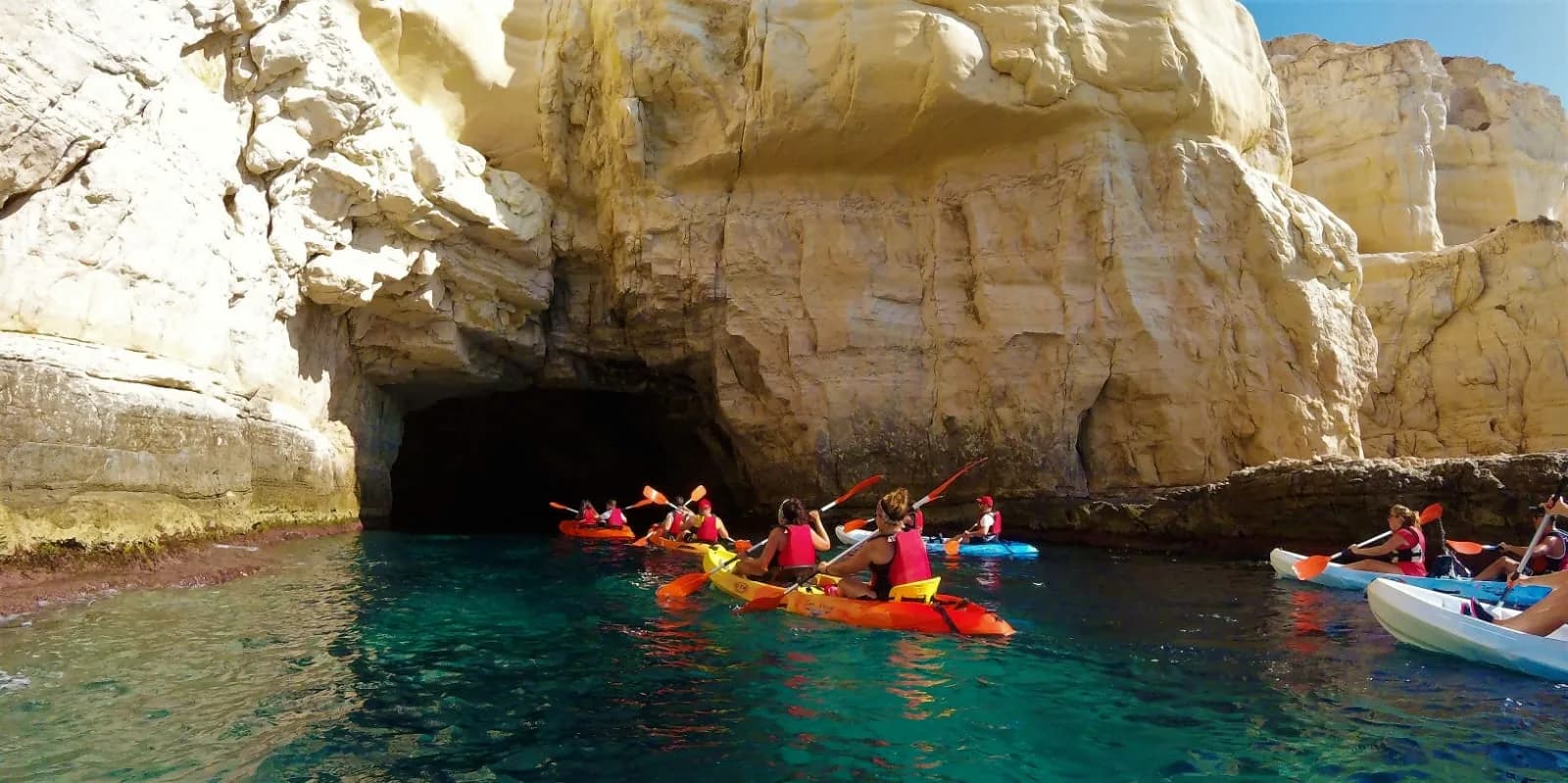
What our clients say
“We had a brilliant excursion! The instructors were friendly and fun. We had a good tour of the coastline and then stopped for snorkelling which was incredible.”Google
“Los mejores monitores, muy pendientes de todo el grupo. Una experiencia increíble y 100% recomendada. El recorrido por cabo de Gata espectacular.”Google
“SOIS LOS MEJORES!! Mágica experiencia que hemos tenido mi familia y yo. Espectacular paseo y belleza de fondo marino que hemos disfrutado. GRACIAS a Lucas y Joaquín por la dedicación, seguridad y el cariño que transmiten.”Google
“Experiencia muy linda! Los guías muy predispuestos y simpáticos! La pasamos muy bien con mi familia, la zona del snorkel fenomenal. Lo disfrutamos mucho! Recomiendo la empresa.”Google
“Experiencia en familia inolvidable! En todo momento nos sentimos seguros, íbamos con dos niñas de 9 y 5 años y los monitores estaban muy pendientes de todos.”Google
“Nos lo hemos pasado estupendamente!! Una gran experiencia, tanto la ruta en kayak con unas vistas preciosas, como el snorkel. Los monitores siempre atentos y muy simpáticos. 100% recomendable!!”Google
Convinced? Book your spot now