
Search for family kayak tours and you'll always find the same thing: lists of marine species, route descriptions and phrases like "ideal for the whole family." What you rarely find is what you actually want to know before booking: whether your child can handle it, what to pack that isn't on any official list, and exactly what is going to happen during those three hours.
This isn't a tourist guide. It's practical information from a parent's perspective — before, during and after.
Before You Book: The Questions That Actually Matter
Does your child meet the age requirement — or just roughly?
The 8-year minimum isn't arbitrary or overly cautious. Sea kayaking in open water requires sustained attention, the ability to follow instructions in unfamiliar conditions and tolerance of physical discomfort for at least three hours. Some 7-year-olds are perfectly ready; some 8-year-olds aren't quite there yet. The question isn't the exact age — it's whether your child can stay focused on one task for 30 minutes at a stretch without a screen. If yes, they're probably ready.
Can they swim, or do they just like water?
A life jacket is mandatory throughout and ensures flotation. But the snorkelling stop — the moment children look forward to most — requires genuine comfort in the water. If your child can't swim confidently, they can stay in the kayak while others go in, which can be frustrating. It's worth being honest about this before booking, not to put you off, but to manage expectations on the day.
How big is the group?
Before confirming any booking, ask for the maximum group size and how many guides will be present. A group of 8 with one guide is a completely different experience to a group of 15. For outings with children, the ideal ratio is no more than 6 participants per guide. If the company can't give you a clear answer, that's worth noting.
Morning, not afternoon
If you can choose a departure time, always choose morning. It's not just about temperature — though the midday heat in July in Almería can be exhausting even for adults. Morning seas are statistically calmer, underwater visibility for snorkelling is better, and children arrive with energy rather than already worn out. Afternoon departures can end with children asleep in the kayak on the way back.

What to Pack: The Real List
The official list says: swimwear, biodegradable SPF 50, water shoes, towel, water. All correct. What it doesn't say:
- A large spare plastic bag. For wet clothes in the car on the way back. It seems obvious and is always forgotten.
- A full change of clothes for the children. Not just a spare swimsuit. Include a dry t-shirt and something warm for afterwards — even in August, children get cold quickly once they're wet and the wind gets up.
- A snack for the car. Not for the break on the water — for the walk back to the car park. Post-kayak hunger with children is a genuine emergency. A piece of fruit or some biscuits in the glove compartment prevents a scene.
- Sunscreen in spray format. Applying cream to a fidgeting child at the water's edge is an Olympic challenge. Spray is faster, easier and gives better coverage on the back.
- Their own snorkel mask if they have one. Snorkel gear is provided, but if your child has their own mask and is used to it, bring it. Comfort with the equipment is the difference between the child who dives 20 metres and the one who won't go in.
What to Expect During the Trip
The first 15 minutes: productive chaos
The on-shore briefing lasts 10–15 minutes. The guide explains paddling technique, life jacket fitting and what to do if the kayak capsizes. Children are running on adrenaline and absorb roughly 40% of the instructions. When they first hit the water, nobody will be paddling in the same direction and someone will be going in circles. This is completely normal and lasts a few minutes. Don't stress about it, and don't stress them about it.
The next 30 minutes: finding the rhythm
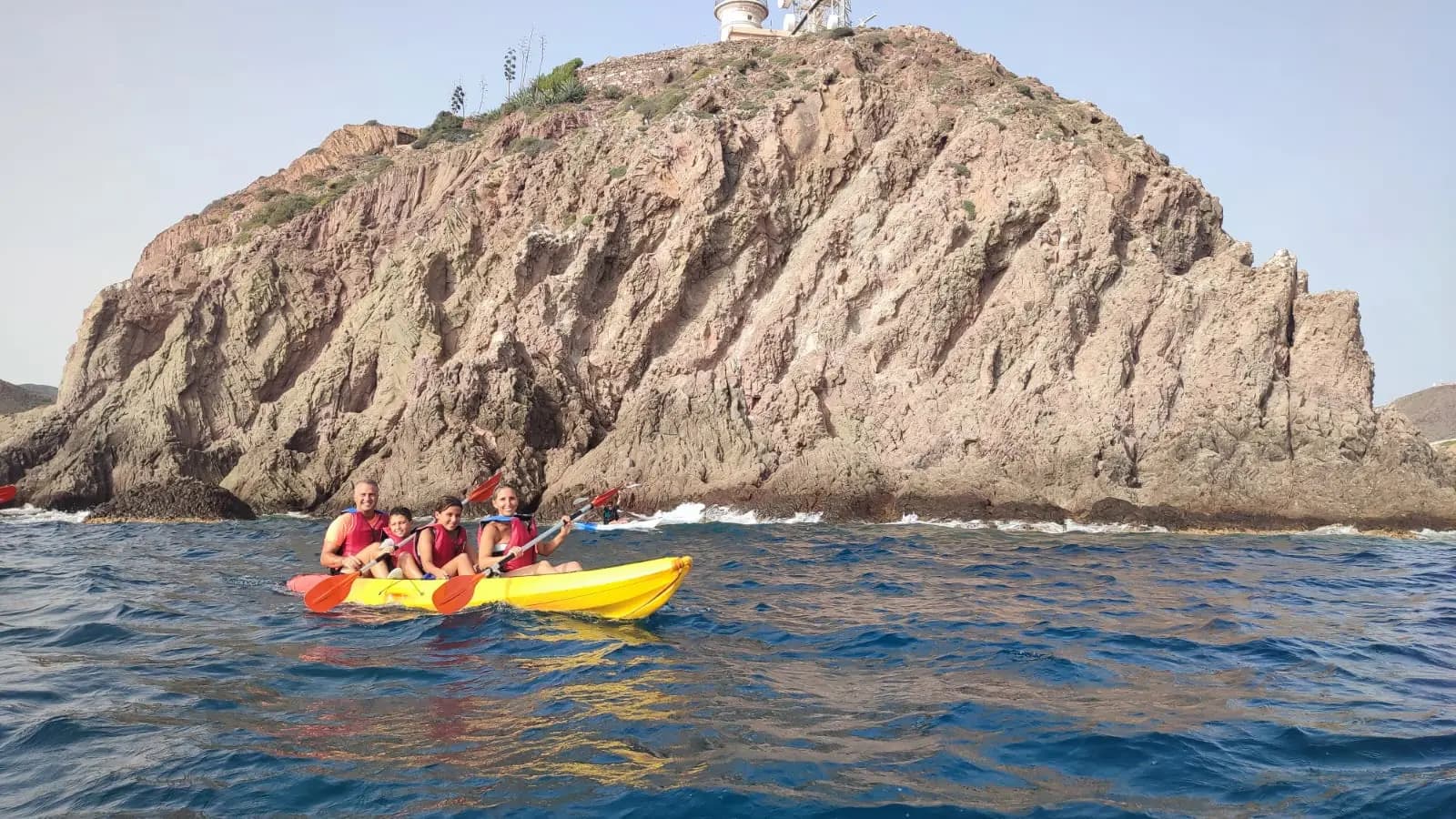
Once the kayak starts moving and children feel they're genuinely contributing to that movement, something shifts. Focus arrives on its own. The cliffs start filling their field of vision. Questions start about what's beneath the surface. This is the moment the trip stops being "an activity their parents chose" and becomes "something they are actually doing."
The snorkelling stop: the moment that changes everything
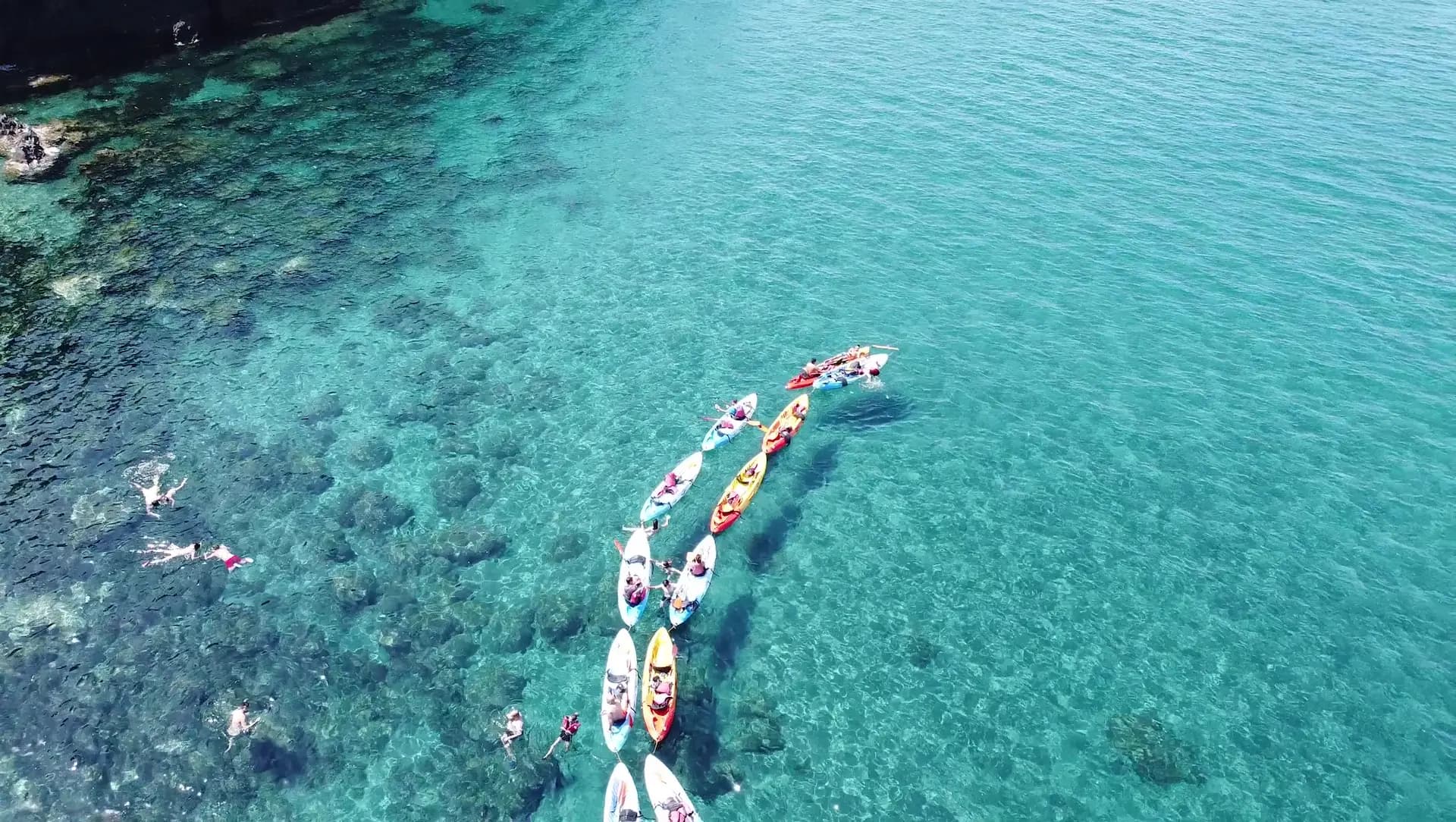
Nobody who has snorkelled in Cabo de Gata for the first time as a child has forgotten it. Visibility can reach 20 metres. On the seabed there are octopuses camouflaged among the rocks, blue and pink parrotfish completely unafraid of humans, shoals of salema that circle your fins. It's like entering an aquarium, but without the glass. The guide knows exactly where the animals are and points them out.
Leave mental room for this stop. It can last 20–30 minutes and children won't want to come out. Neither will you.
The return: the effort that doesn't feel like effort
The return leg is usually into the wind — the most physically demanding stretch, and where the difference between 9 and 40 most clearly shows. The guides know the right pace and leave nobody behind. By the time you're back at the launch point, children will be tired in a way few activities achieve: the clean tiredness of having done something real, outside, on the water.
What You Didn't Expect — and What Turns Out to Be the Best Part
There are three moments that parents remember more vividly than their children — although their children remember them too, in their own way.
The first is the silence inside a sea cave. When the kayak enters one of the volcanic caves and the outside noise cuts off, children stop talking by themselves. It's instinctive. The echo of the water, the light filtering in from below, the black rock half a metre from your face. There's something very ancient in that sensation.
The second is seeing an octopus without glass between you. Not in an aquarium, not in a photo. Right there, 50 centimetres away, changing colour. The guide points it out, everyone looks, the octopus ignores them. For many children — and many adults — it's the first time nature hasn't placed a barrier between them and it.
The third is what your child says in the car on the way back. They might say nothing. They might say "can we come back tomorrow?" They might spend the rest of the holiday talking about the octopus. In any of these cases, you know it went well.
For detailed information on safety protocols specific to groups with children, frequently asked questions and equipment recommendations, see the full guide at zonaktiva.com — more information on safety with children.
Tags: